When people talk about AI in schools, the conversation often turns to exams and homework. Less often does it turn to the question many teachers face on a Sunday evening: how do I get through all this preparation? On that question, there is now a solid measurement.
What the trial measured
In 2024, the Education Endowment Foundation (EEF) ran a trial in England with 259 teachers from 68 schools, evaluated by the research institute NFER. Schools were randomly assigned to two groups: one used ChatGPT for lesson preparation, the other prepared without AI.
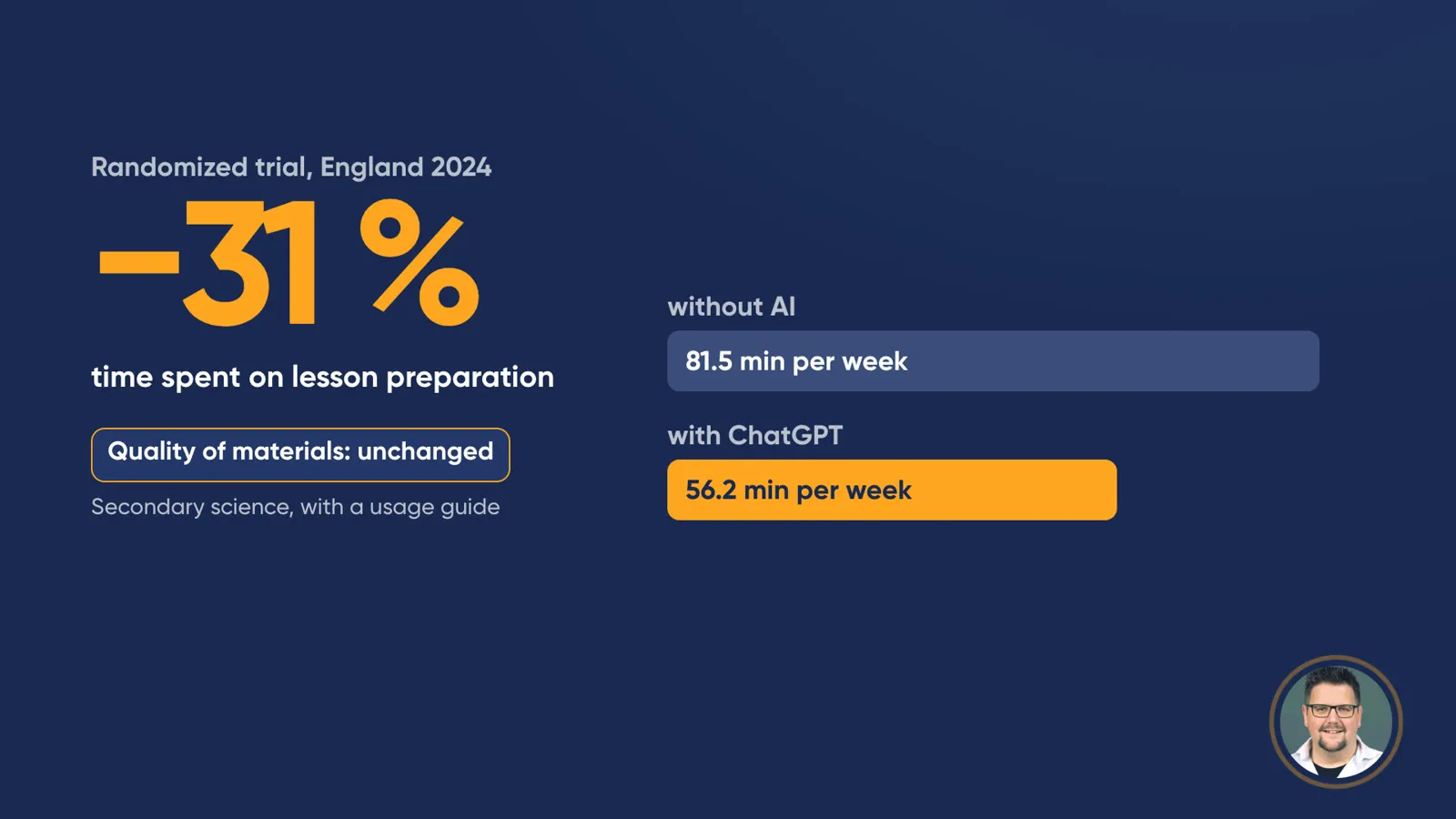
With ChatGPT, teachers spent 31 percent less time on lesson preparation, with no drop in quality.
The result: the ChatGPT group spent an average of 56.2 instead of 81.5 minutes a week, a little over 25 minutes or 31 percent less. An expert panel rated the materials from both groups without knowing where they came from. It found no difference in quality.
What the trial doesn’t tell you
The trial looked at secondary school science (Years 7 and 8 in the English system), and the teachers had a guide on how to use the tool. Whether the figure carries over to other subjects, other age groups or use without guidance is not something the trial answers.
The three time sinks below don’t come from the trial either. They are my recommendation for where the same idea applies: the AI delivers a draft, and the teacher turns it into something usable. Course leaders in continuing education can apply this too, for example to course announcements, messages to participants or rubrics for course assignments. The trial did not measure that.
Three time sinks to hand over
- Letters to parents and announcements. The AI writes the first draft, you adjust tone and content.
- Differentiation. The same task at three levels of difficulty, or a text in plain language.
- Grading rubrics. The AI suggests criteria and levels, you sharpen them.
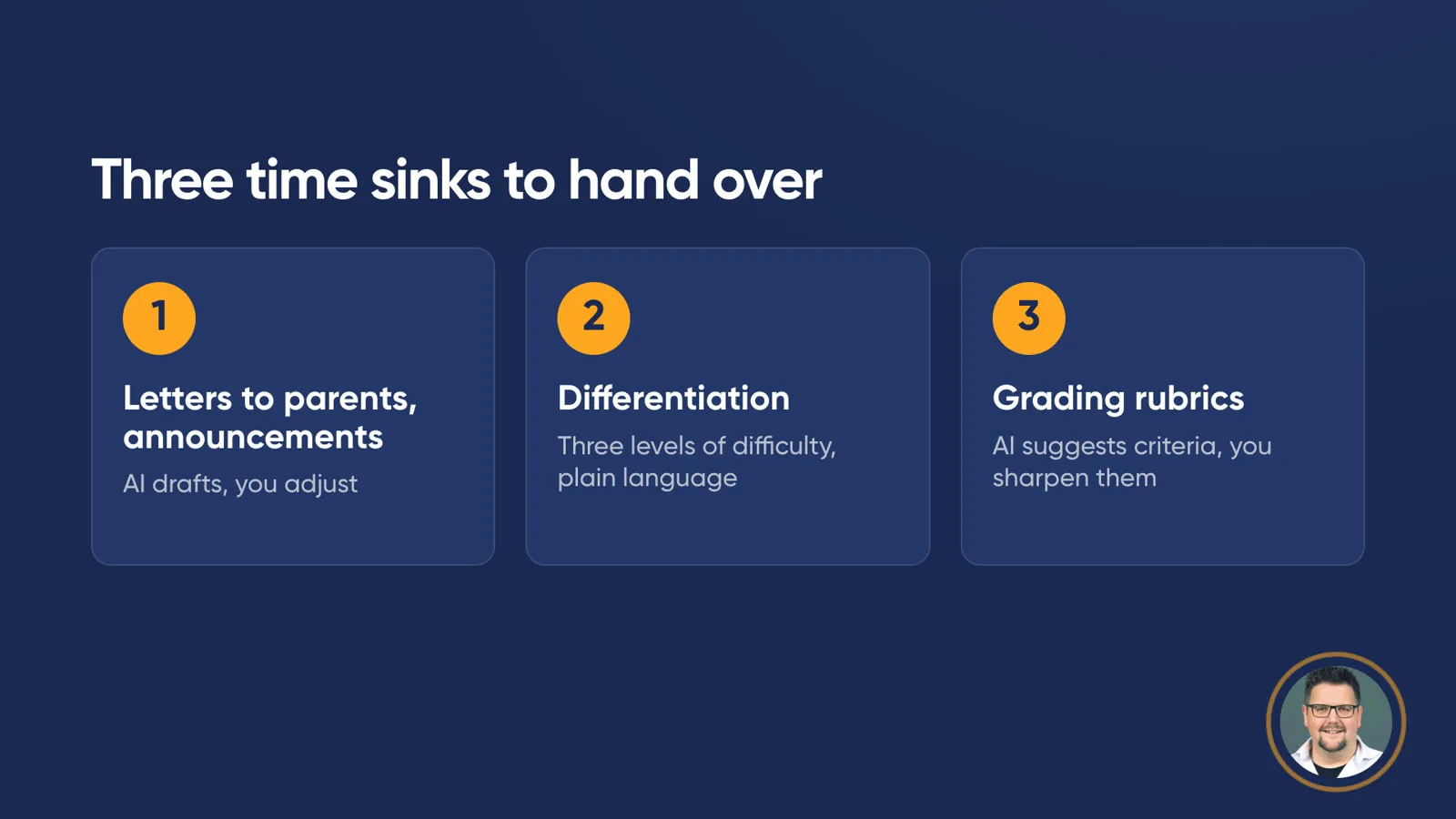
Three tasks where the AI can take on the first draft.
The boundary stays clear
The AI delivers drafts, you make the decisions. That holds for all three tasks: whatever goes out is your responsibility. And personal data stays out. The public schools of the Canton of Zurich make the same point in their guidance on AI. My tip: draft a letter to parents with placeholders such as “[name]” or “[date]” and fill them in only at the very end.
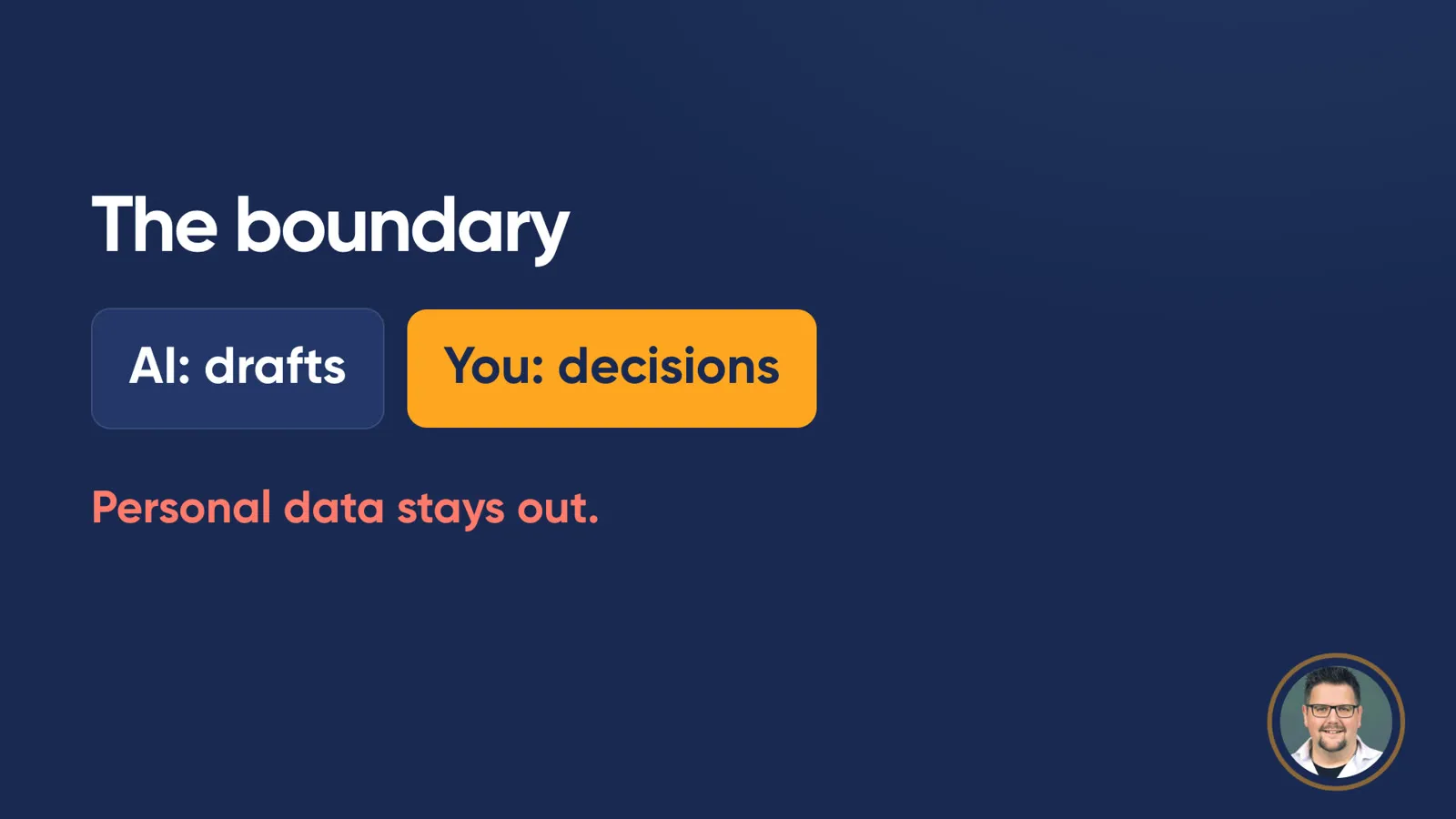
The AI delivers drafts, you make the decisions, and personal data stays out.
My suggestion to try
Pick a single time sink for next week, not all three. For differentiation, for example: give the AI a task from your current teaching, without any details about your class, and ask for three versions, an easier one, the original and a more demanding one. Then check: is the content correct? Does the level suit your learners? What would you change?
Make a rough note of how long it would have taken you and how long it took with a draft. After a week you will know from your own experience whether it pays off for you, rather than relying on an average from England.
Time saved is time for relationships and good feedback.
Frequently asked questions
Does AI save teachers time on lesson preparation?
In a randomised trial by the Education Endowment Foundation (2024) with 259 teachers in England, the ChatGPT group spent 31 percent less time, 56.2 instead of 81.5 minutes a week. An expert panel found no difference in the quality of the materials.
Does the result apply to other subjects?
The trial doesn't answer that. It looked at secondary school science (Years 7 and 8 in the English system), and the teachers had a guide on how to use the tool.
Which tasks can teachers hand over to AI?
The post suggests three: drafts of letters to parents and announcements, differentiation into several levels of difficulty, and suggestions for grading rubrics. The AI delivers drafts, the teacher decides, and personal data stays out.