“What’s your learning style?” The idea behind this question is widespread among educators, including in adult education. Visual, auditory or kinaesthetic, and if you’re taught in your style, you learn better. The idea is intuitive, widespread and well meant. It just isn’t supported by evidence.
What the research says
In 2008, Harold Pashler, Mark McDaniel, Doug Rohrer and Robert Bjork reviewed the evidence for the Association for Psychological Science. Their question was precise: do people learn better when teaching matches their preferred learning style?

Preferring a format does not mean you learn better with it.
Testing this properly requires a specific design: learners with different styles are randomly assigned to different teaching methods, and everyone then takes the same test. The researchers found only a few such studies. Those studies didn’t show the expected effect, and several flatly contradicted it. Their conclusion: there is no adequate evidence for tailoring teaching to learning styles.
A more recent meta-analysis from 2024 finds small effects under certain conditions. That changes little in practice: the effort spent on learning style tests and tailored materials is out of proportion to any possible benefit.
Why the myth persists
Most educators still believe in it. In 2020, Philip Newton and Atharva Salvi analysed 37 studies covering more than 15,000 teachers and trainers in 18 countries. Weighted, around 89 percent said they believe in matching instruction to learning styles, roughly nine out of ten.

No evidence for learning styles, yet around 89 percent of teachers believe in them.
One reason: the idea contains a grain of truth. We all have preferences. Some people prefer reading, others prefer listening. But a preference doesn’t mean we learn better that way. Rogowsky and colleagues tested exactly this in 2015: adults who described themselves as readers or listeners did not learn better with their matching format.
What works instead
Match the format to the content, not the person. A process needs a diagram, pronunciation needs sound, a hands-on skill needs practice. That choice is the same for every participant.
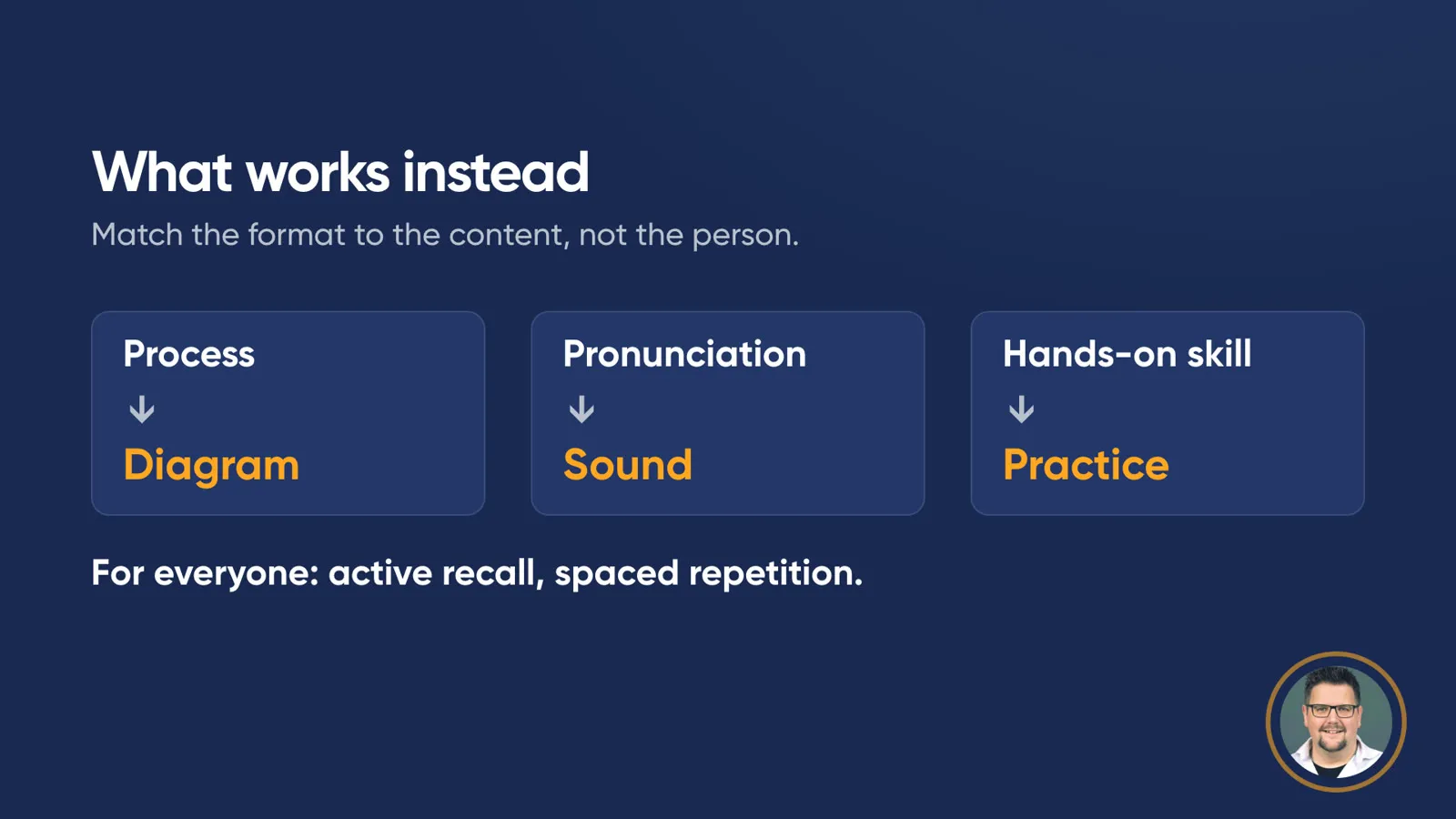
The format follows the content, not a learning style.
Active recall and spaced repetition. Both are among the best-supported learning techniques there are. More on this in the post on the forgetting curve.
My suggestion for your next course
Drop the learning style test at the start. Use the time for a short quiz on what participants already know. It tells you more about the group than any typology, and it doubles as the first recall exercise.
And when you plan materials, don’t ask “What do participants like?” Ask “What does this content need?”
Frequently asked questions
Are learning styles real?
There is no adequate evidence that people learn better when teaching matches their learning style. That was the conclusion of Pashler and colleagues after reviewing the evidence in 2008. We all have preferences, but a preference doesn't mean we learn better that way.
How many teachers believe in learning styles?
In 2020, Newton and Salvi analysed 37 studies covering more than 15,000 teachers and trainers in 18 countries. Weighted, around 89 percent said they believe in matching instruction to learning styles, roughly nine out of ten.
What works better than teaching to learning styles?
Match the format to the content, not the person: a process needs a diagram, pronunciation needs sound, a hands-on skill needs practice. For everyone, active recall and spaced repetition help.