When we plan a course, we tend to focus on the moment of teaching: good slides, a clear explanation, a fitting exercise. What happens to the material afterwards is often left to chance. Yet it is exactly this afterwards that decides how much sticks. Hermann Ebbinghaus showed this as early as 1885.
A self-experiment with nonsense syllables
Ebbinghaus was both experimenter and subject. He memorised lists of nonsense syllables and tested how much remained after intervals ranging from 20 minutes to 31 days. His measure was the savings method: how much less effort does it take to learn a list again?
The result is the forgetting curve. It drops steeply at first and then levels off. In 2015, Murre and Dros repeated the experiment, again with a single subject, over roughly 70 hours. Their results were similar to Ebbinghaus’ original data.
What the curve doesn’t tell you
Be careful with precise percentages that circulate online, such as how much you supposedly forget after a week. Ebbinghaus’ figures apply to nonsense syllables in a self-experiment and don’t transfer neatly to course content. That’s why the video shows the curve as a schematic, without measured values.
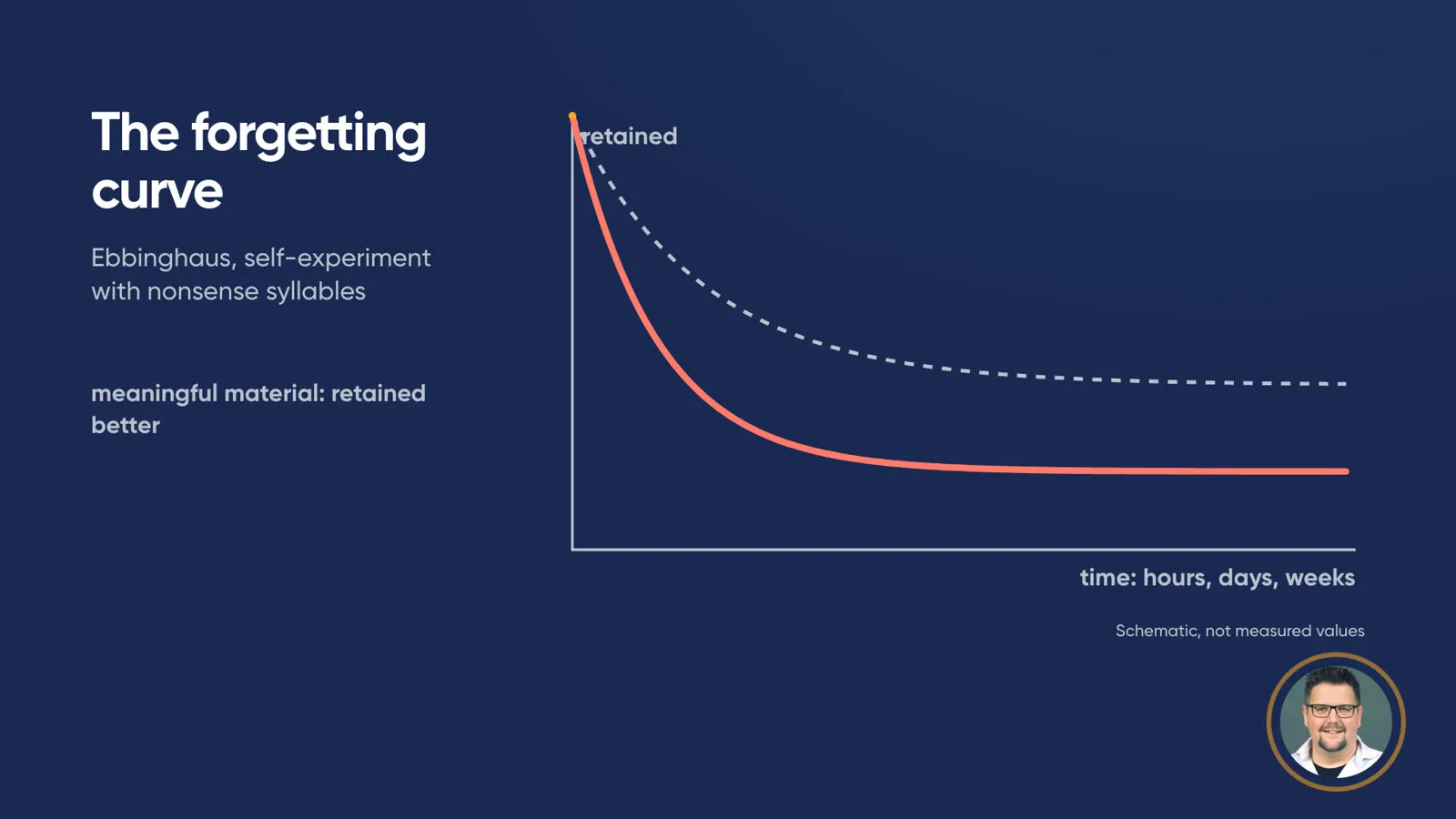
Schematic: meaningful material is retained better than nonsense syllables.
Meaningful material is retained better. Ebbinghaus himself found that stanzas from Byron’s “Don Juan” needed only a fraction of the repetitions. But the principle holds: without repetition, meaningful material fades too.
Repetition changes the curve
The good news comes from Ebbinghaus as well. When he relearned the same list on several days, his savings grew. Put simply: every repetition pulls the curve back up, and afterwards it falls more gently than before.
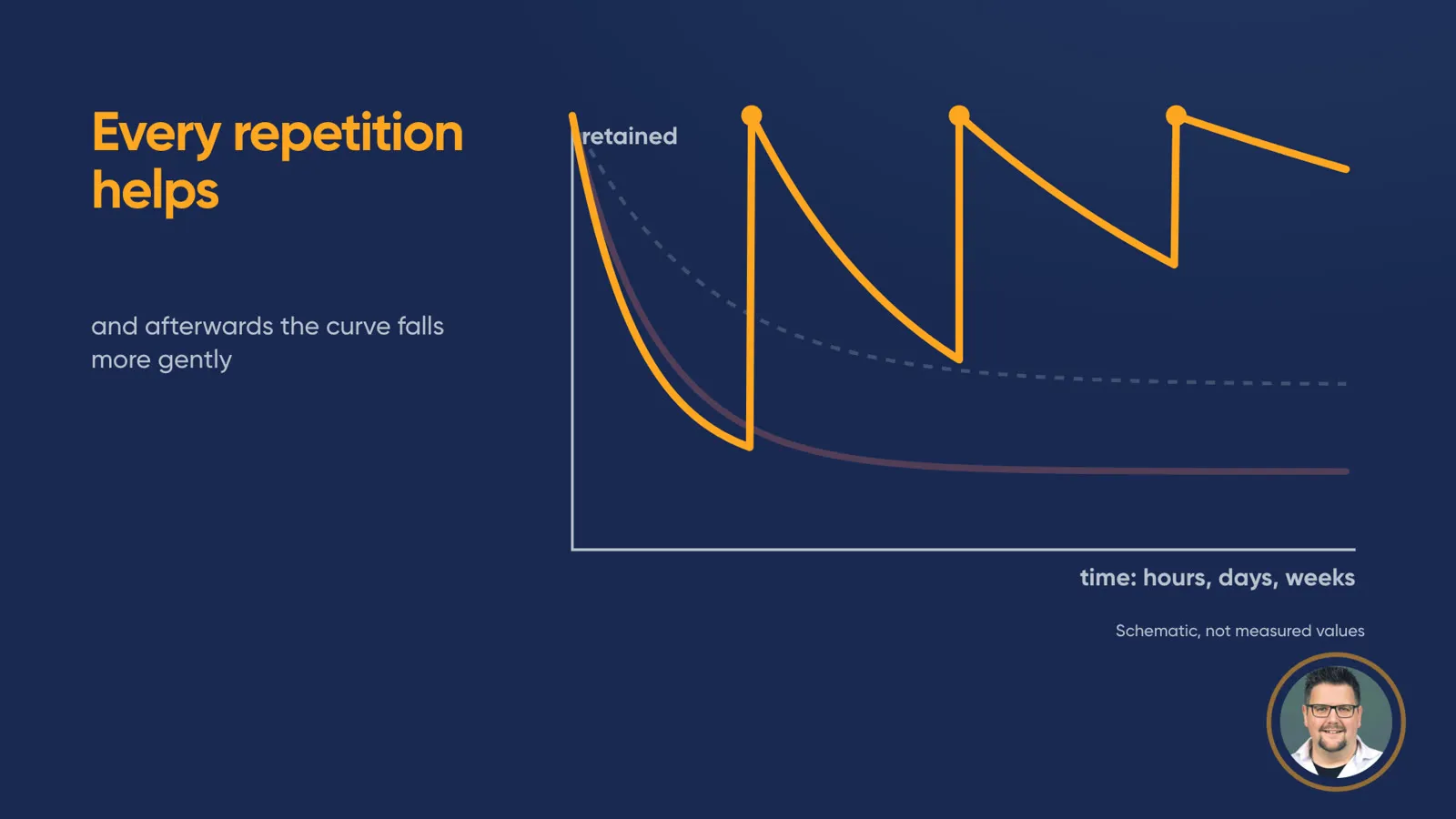
Each repetition pulls the curve back up, and afterwards it falls more gently.
Current learning research points the same way. In 2013, Dunlosky and colleagues rated common learning techniques by how useful they are. Distributed practice and practice testing came out on top, while rereading was rated low. As Dunlosky puts it, almost any kind of practice test helps.
Three things for your courses
- Plan repetition, spaced over days and weeks, instead of cramming everything into one day.
- Test instead of rereading. Actively recalling something sticks better than going over the text again.
- Build in short moments of recall, for example a quiz at the start of the next lesson.
My suggestion for your next lesson
Open the lesson with three to five short questions: two on the previous lesson, one on a topic from a few weeks back. No grades, and the answers follow straight away. It takes a few minutes and combines exactly the two techniques that scored best in Dunlosky’s review: testing and spacing.

Repetition works as a rhythm, not as a one-off event.
And an exercise for you as the course designer: take your current course plan and mark, for every key topic, when it comes up a second time after it was first taught. Wherever there is no mark, the course is quietly planning for forgetting.
Learning is not a one-time event. It’s a rhythm.
Frequently asked questions
What is the forgetting curve?
The forgetting curve describes how quickly learned material fades without repetition. Hermann Ebbinghaus measured it in 1885 in a self-experiment with nonsense syllables: it drops steeply at first and then levels off.
How much do we forget after a week?
There is no universal percentage. Ebbinghaus' figures apply to nonsense syllables in a self-experiment and don't transfer neatly to course content; meaningful material is retained better.
How can you slow down forgetting?
Through repetition: every repetition pulls the curve back up, and afterwards it falls more gently. In the review by Dunlosky and colleagues (2013), distributed practice and practice testing came out on top, while rereading was rated low.
Sources
- Ebbinghaus: Memory, Chapter 7 (1885, English translation)
- Ebbinghaus: Memory, Chapter 8 (1885, English translation)
- Murre & Dros: Replication and Analysis of Ebbinghaus’ Forgetting Curve, PLOS ONE (2015)
- Dunlosky et al.: Improving Students’ Learning With Effective Learning Techniques, PSPI (2013)
- Dunlosky: Strengthening the Student Toolbox, American Educator (2013)
Reuse