AI can write you an entire exam in ten seconds. Impressive, but it leaves the more important question open: should you use it as is? Many of us work with AI on the principle of hope. Prompt in, result out, done. That saves time, right up until the first wrong answer key is in circulation.
What’s missing is rarely a better tool. It’s a competency model: a shared idea of what good work with AI actually looks like. One such model is the four Ds.
Where the four Ds come from
The four Ds are part of the AI Fluency Framework by Rick Dakan (Ringling College of Art and Design) and Joseph Feller (University College Cork), developed in collaboration with Anthropic. The framework describes AI fluency as the ability to work with AI effectively, efficiently, ethically and safely. It comes with free courses, including courses for educators.
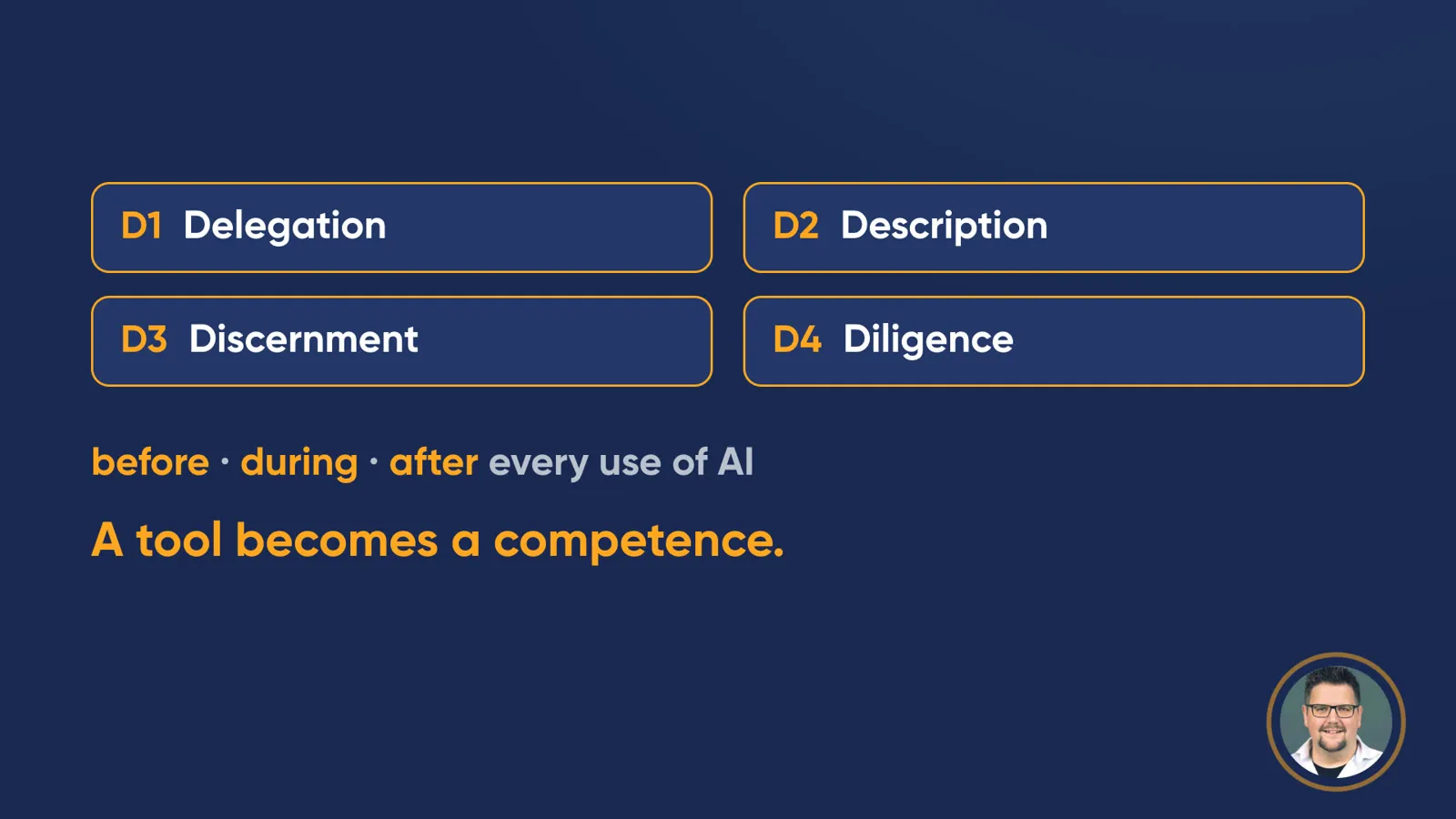
The four Ds accompany every use of AI: before, during and after.
The four Ds at a glance
Delegation: hand over consciously. Decide what the AI takes over and what stays with you. Having it suggest practice questions for a text? Sure. Grading a final thesis stays with you.
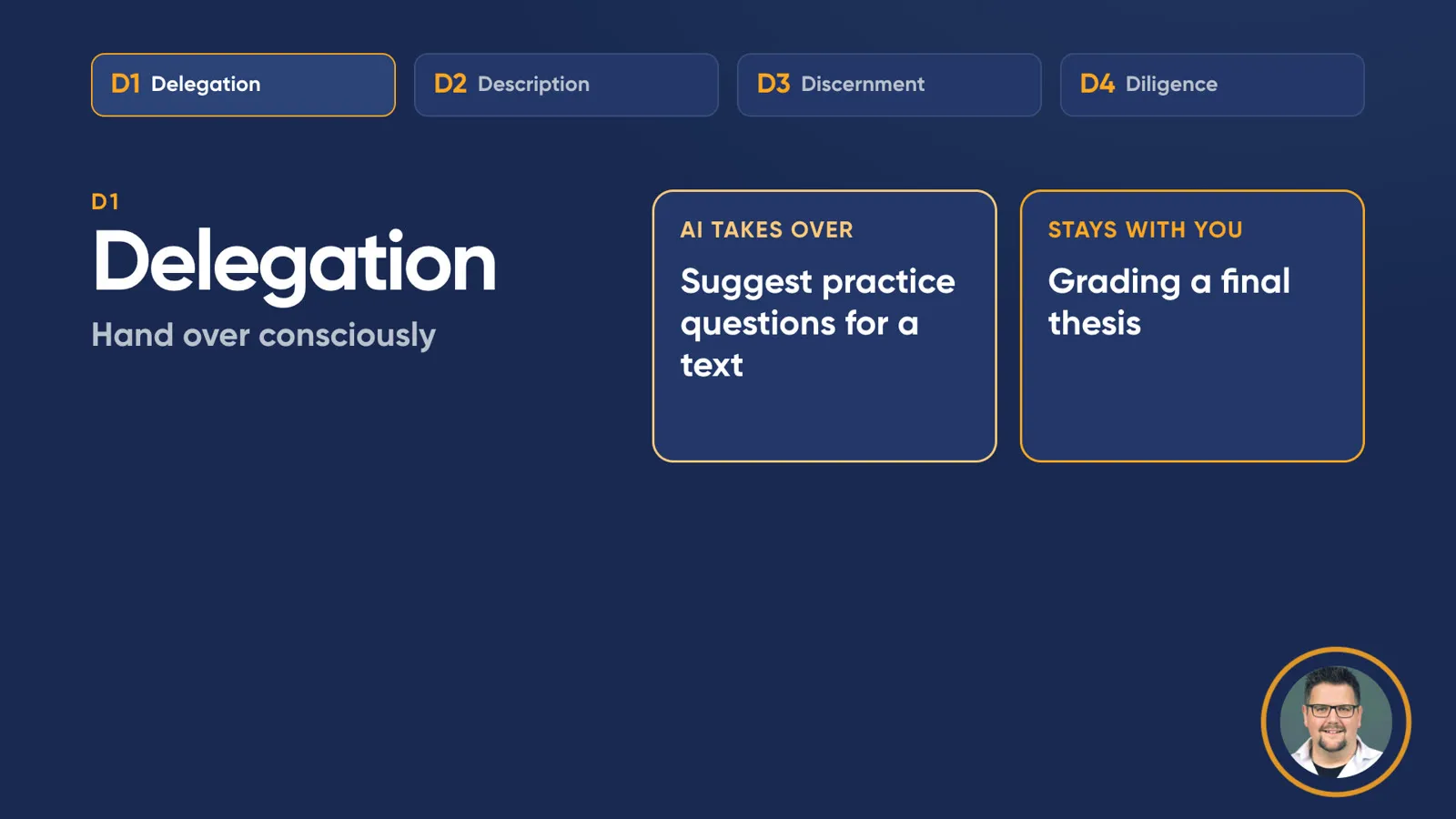
Delegation: the AI may suggest practice questions, grading a final thesis stays with you.
Description: describe clearly. The AI doesn’t know your class. Tell it who is learning, what the goal is and what the result should look like. The clearer the brief, the more useful the answer.
Discernment: check critically. Is the content right? Is the level right? AI doesn’t become dangerous when it’s often wrong. It becomes dangerous when it’s almost always right and we stop checking.
Diligence: take responsibility. You are responsible for what you use. That means no personal data of learners in third-party tools, and being open about where AI was involved.
A worked example: questions on a factual text
Here is the example from the video, played through all four Ds. How each step is filled in is my suggestion:
- Delegation: the AI drafts practice questions. You decide which ones make it into the lesson.
- Description: “Upper secondary, year 2, second-language learners. Goal: identify the arguments in a factual text. Result: five questions with an answer key, one page maximum.”
- Discernment: you go through every answer in the key. Is it correct? Does the language suit this class?
- Diligence: the brief contains no names or data about your learners, and the worksheet states that the questions were created with AI support.
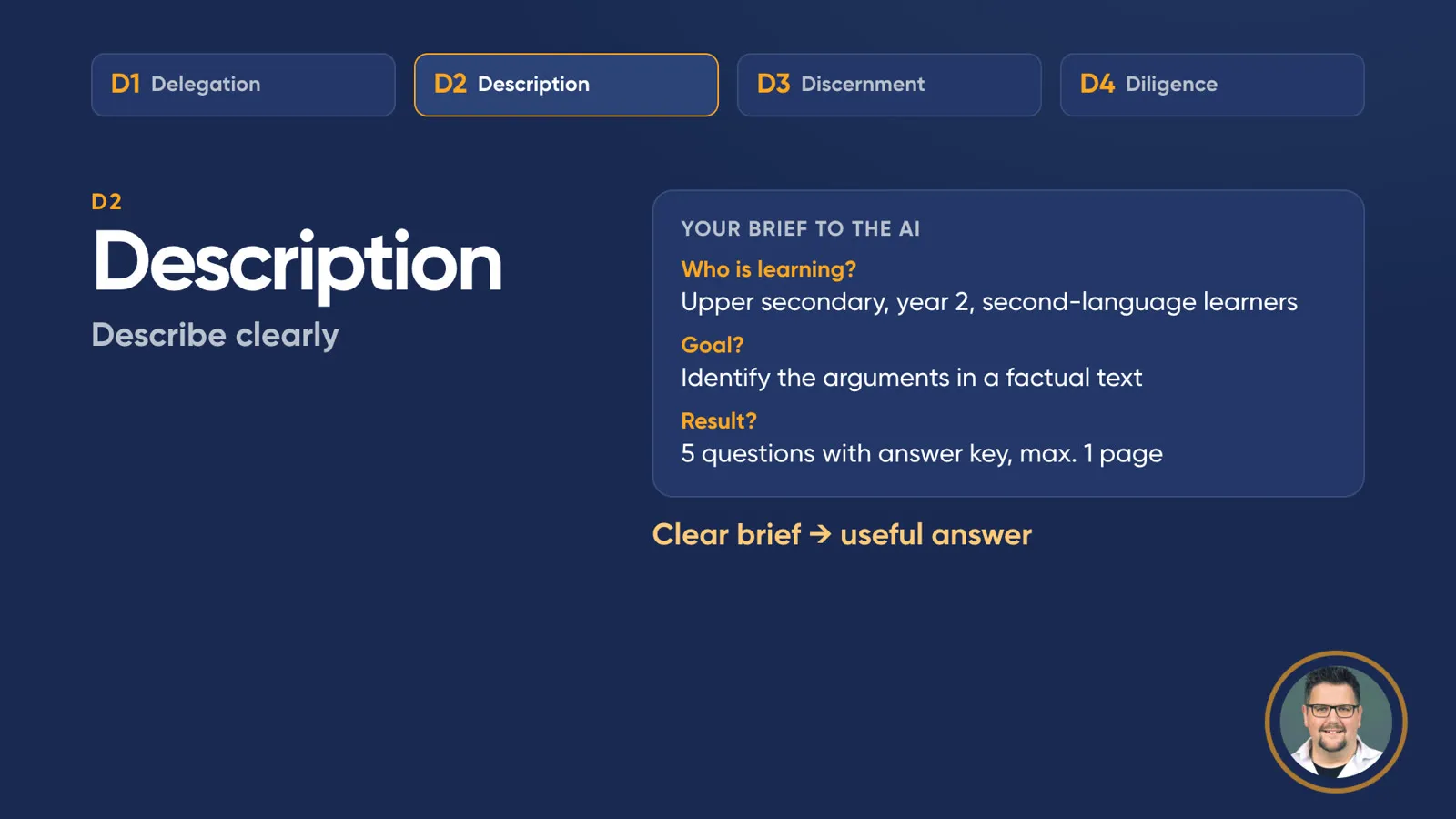
A clear brief names the learners, the learning goal and the expected result.
An exercise for you
My suggestion for your next planning session: take the last piece of material you created with AI and run it through four questions.
- What did I hand over? Should any of it have stayed with me?
- Did the AI know enough? Who is learning, what is the goal, what should the result look like?
- Did I check, or just skim? Content and level, line by line.
- Where does my responsibility lie? Did learner data end up in the tool? Is it clear where AI was involved?
The D that makes you hesitate longest is usually the one worth practising.
Four questions before, during and after every use of AI. That’s how a tool becomes a competence, for you and for your learners.
Frequently asked questions
What is AI fluency?
The AI Fluency Framework by Rick Dakan and Joseph Feller, developed in collaboration with Anthropic, describes it as the ability to work with AI effectively, efficiently, ethically and safely. The four Ds are part of it.
What are the four Ds?
Delegation means handing over consciously, Description describing clearly, Discernment checking critically and Diligence taking responsibility. Diligence includes keeping personal data of learners out of third-party tools and being open about where AI was involved.