“This course is also available online.” It sounds like a clear answer, yet it tells you surprisingly little. It might mean a live lesson in a video call, a classroom course backed by a digital learning platform, or a learning path you work through entirely on your own. All three carry the same label. For learners, they feel completely different.
Why “classroom or online?” falls short
The usual question only looks at location. But location is not what defines a learning offer from a teaching perspective. Teaching with fixed times is still a timetable, even in a video call. Learners save the commute, but the school still decides when and at what pace they learn.
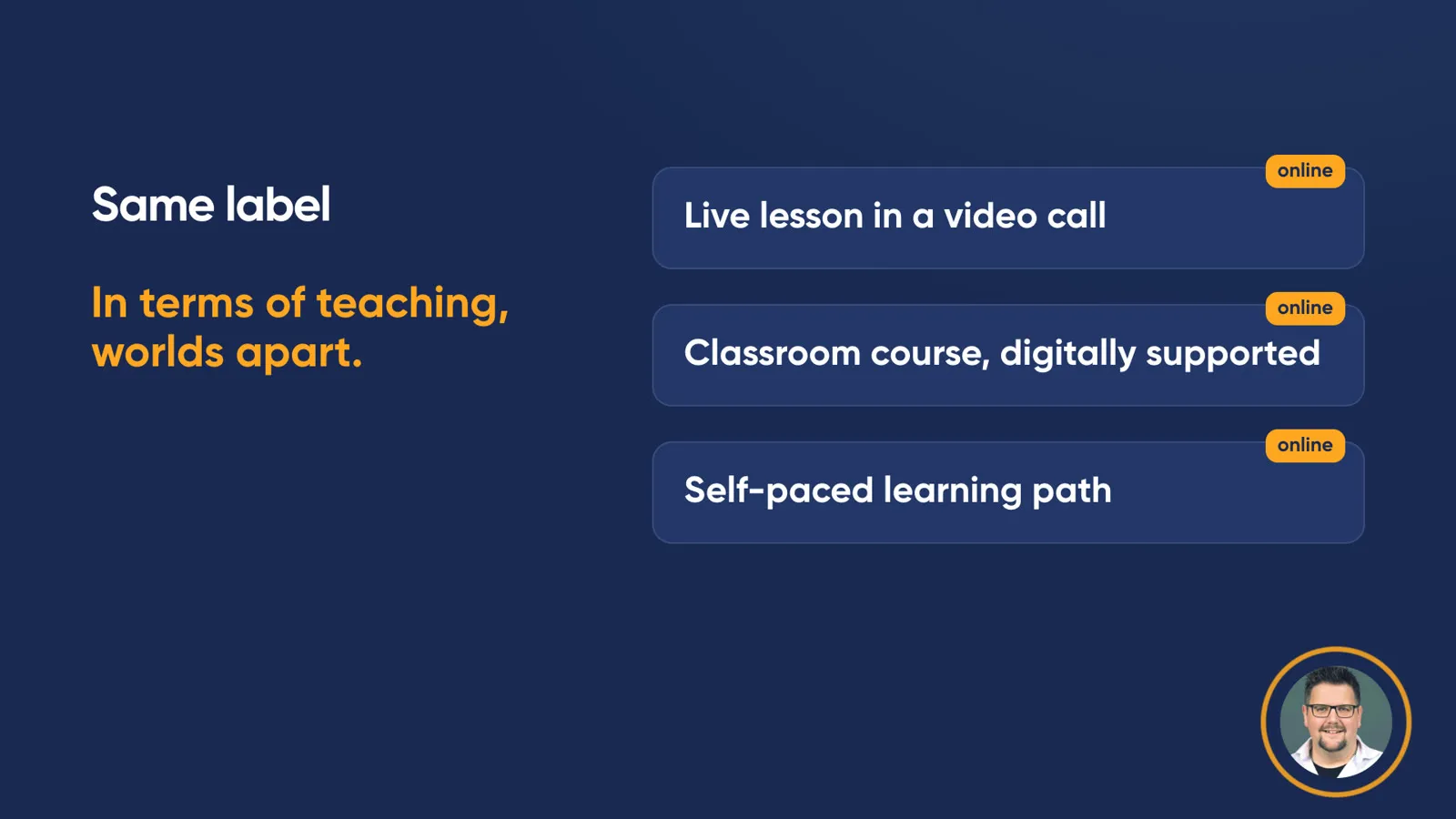
Three very different offerings, all with the same “online” label.
Three dimensions instead of one
That is why I describe learning offers along three dimensions:
- Flexibility: Who decides place, time and pace?
- Guidance and commitment: How much does the school structure and accompany learning?
- Self-regulation: How much planning and stamina does the model demand from learners?
Together they give four types: the online classroom, the school with a digital learning ecosystem, the digital self-study model, and the modular system that offers several formats side by side. The typology is a conceptual model for commercial continuing education, not a rating of individual schools.
These dimensions did not come out of nowhere. The Community of Inquiry model by Garrison, Anderson and Archer (2000) describes, alongside social and cognitive presence, a teaching presence in online learning: the way teachers design and guide the learning process. That is close to my second dimension.
Flexibility comes at a price
More flexibility shifts responsibility to the learners. If you choose your own place, time and pace, you also have to plan, keep going and track your own progress. A review by Broadbent and Poon (2015) found that such self-regulation strategies, time management among them, are linked to achievement in online learning.
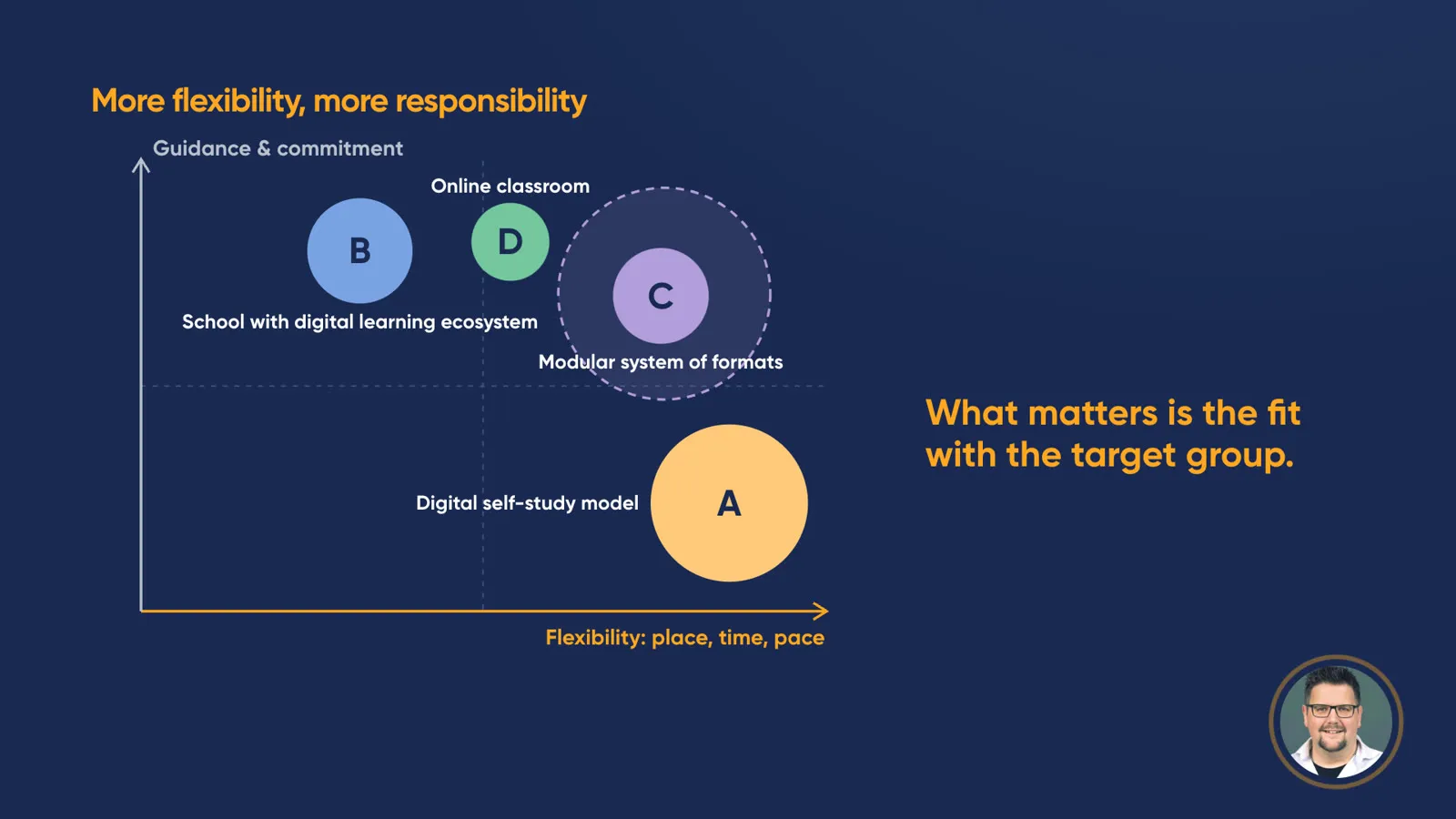
The more flexible the format, the more responsibility shifts to the learners.
So the most flexible model is not automatically the best. What matters is the fit with the target group.
An exercise for your team
Here is my suggestion for your next team meeting: take one of your own courses and rate it on the three dimensions, from “low” to “high”. Then ask three questions:
- Is the description accurate? Would someone from the target group place the course the same way based on the brochure?
- Does the demand for self-regulation match the target group? People learning alongside work and family may want flexibility, but also clear milestones.
- Where is support missing? If you offer a lot of flexibility, what do you give learners so they can handle it?
The better question: which balance fits which target group?
The answers usually lead to the real question: do we need more flexible offers, or better support for handling flexibility? Not classroom or online, but the balance of flexibility, guidance and self-responsibility that fits your learners.
Frequently asked questions
What does "online" mean for a course?
The label says little: it can mean a live lesson in a video call, a classroom course backed by a digital learning platform, or a learning path you work through on your own. For learners, these feel completely different.
How do I choose the right learning format?
Instead of asking "classroom or online?", look at three dimensions: flexibility, guidance and commitment, and self-regulation. What matters is the fit with the target group; the most flexible model is not automatically the best.
Why does self-regulation matter in online learning?
More flexibility shifts responsibility to learners: they have to plan, keep going and track their own progress. A review by Broadbent and Poon (2015) found that self-regulation strategies such as time management are linked to achievement in online learning.