“Summarise the text and answer the questions.” An AI can finish homework like this in a few seconds. The obvious reflex is to ban AI. That’s understandable, but it achieves little: what happens at home can hardly be controlled. A different question is more useful: how does an assignment need to be built so that the thinking still stays with the learners?
The problem is the assignment, not the tool
An assignment that only asks for a finished product ends up mostly checking whether a text was handed in. You can’t tell from the text who wrote it. So AI-robust doesn’t mean locking AI out. It means designing assignments in a way that makes real understanding visible.
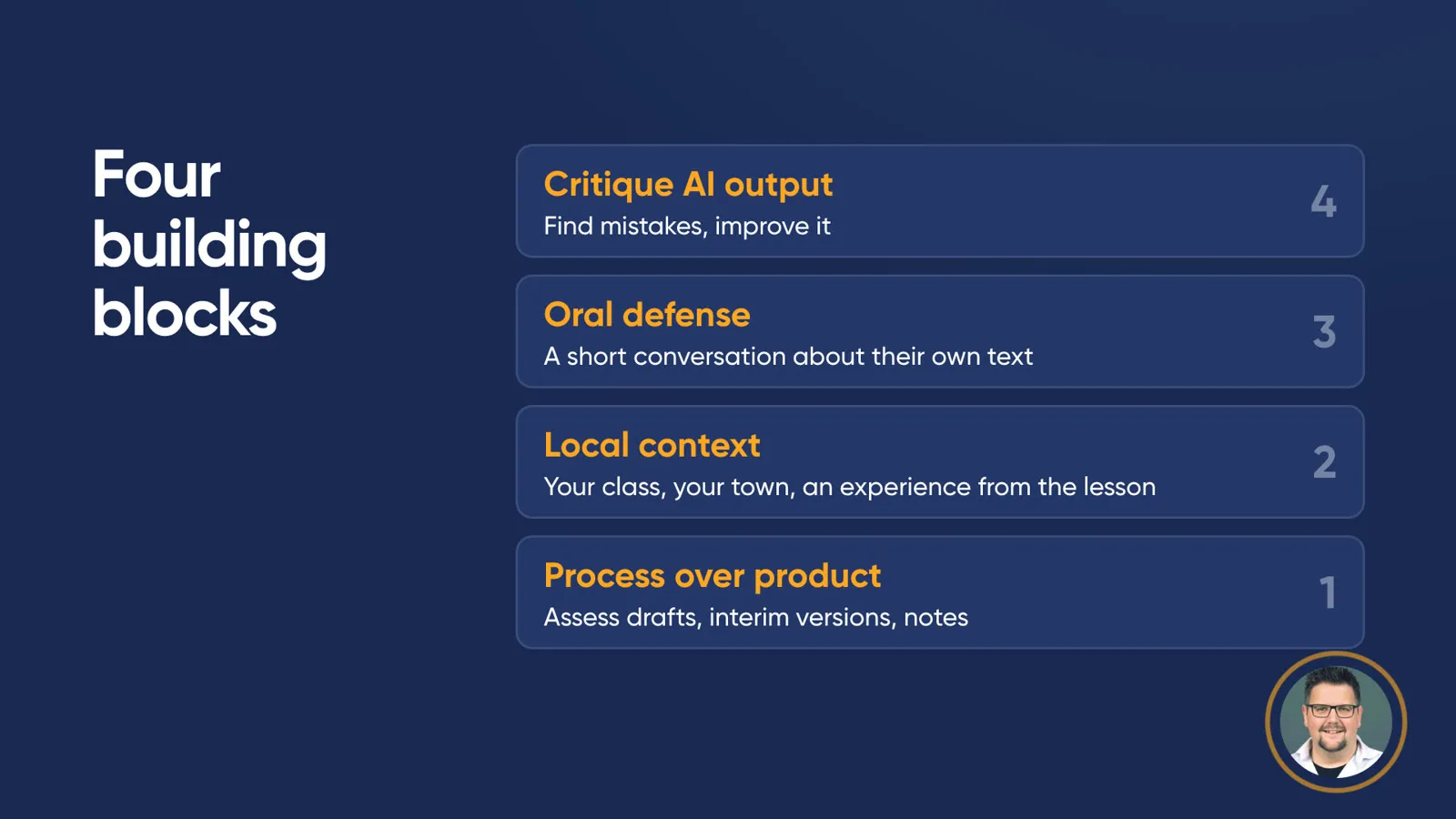
Four building blocks for redesigning an assignment to be AI-robust.
Four building blocks
1. Process over product. Assess not only the result, but also drafts, interim versions and notes. The ZHAW (Zurich University of Applied Sciences) states this explicitly in its guideline on AI in assessments: not just the end product can be graded, but also the working phase, in other words a process assessment.
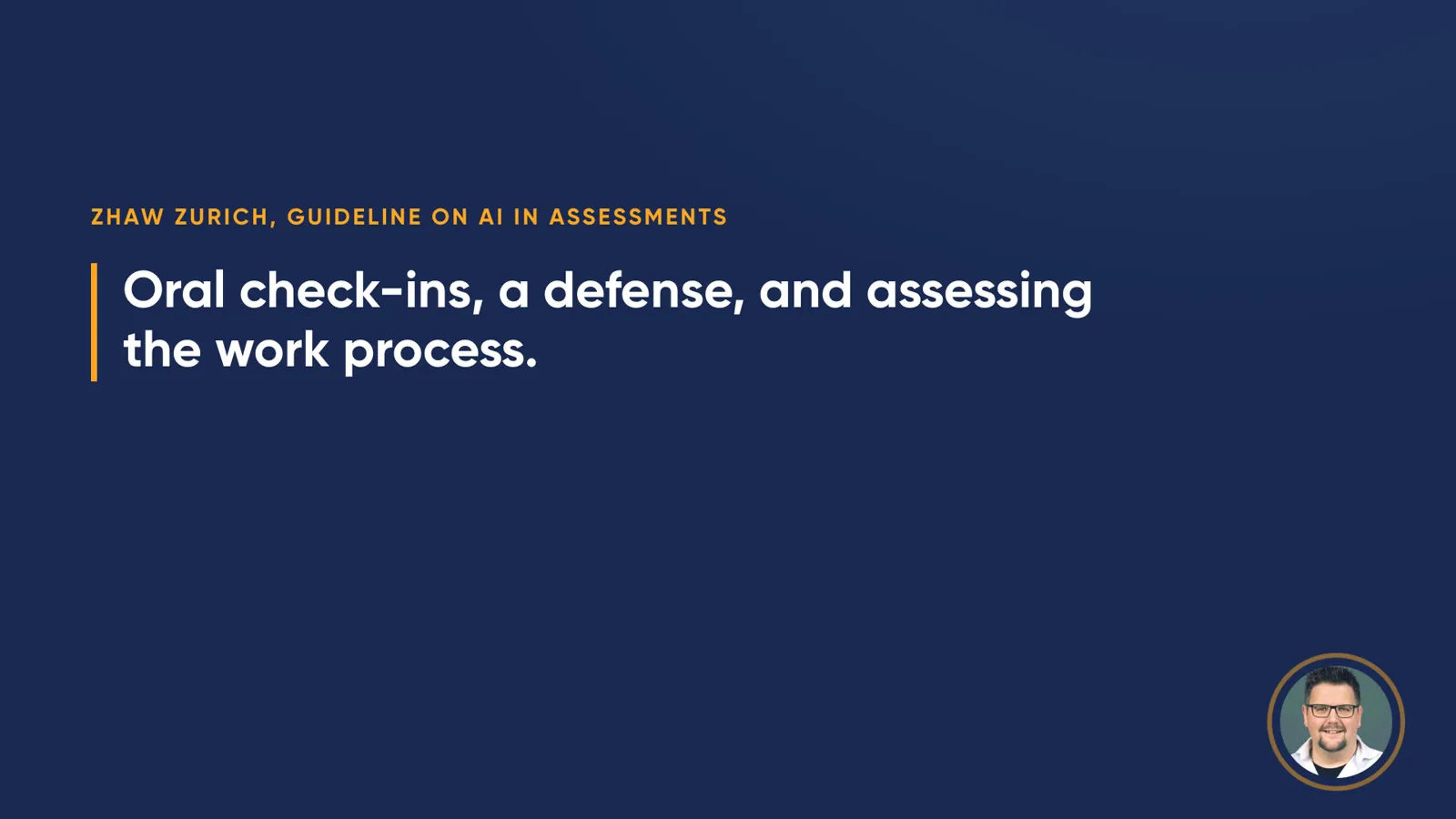
The ZHAW guideline also names conversations and assessing the work process.
2. Local context. Connect the task to your class, your town or an experience from the lesson. What your class discussed last week is something no AI knows. It isn’t watertight: anyone who feeds the AI the context will still get an answer. But to do that, learners have to engage with what they experienced.
3. Oral defence. A short conversation quickly shows whether someone understands their own text. The ZHAW guideline mentions graded oral check-ins and defences. According to Swiss broadcaster SRF, oral formats are gaining weight at Swiss universities.
4. Let learners critique AI output. Learners check an AI answer, find mistakes and improve it. That turns AI from a shortcut into something to learn from.
Building blocks 2 and 4 are my own recommendations from teaching practice. Building blocks 1 and 3 are directly backed by the ZHAW guideline. The examples come from school, but the building blocks work just as well in continuing education courses: the class becomes the course group, and the classroom becomes the training room or the participants’ own workplace.
My suggestion: redesign one assignment
Take the homework from the opening and redesign it in three steps:
- Instead of a summary, have an AI write one and give it to your learners with the task: mark what’s missing, what’s wrong and what you would weight differently.
- Instead of generic questions, ask for a link to your lessons: where does the text contradict what you discussed in the last lesson?
- Instead of just handing it in, have a conversation of a few minutes with some of the learners about their corrections. The notes from steps 1 and 2 count towards the grade.
That puts all four building blocks into a single assignment. You control the effort yourself: you decide how many learners you talk to.
AI-robust doesn’t mean AI-free
None of these building blocks bans AI. It can help with research, with wording, and can even be the subject of the assignment. What matters is that the thinking visibly stays with the learners: in the process, in the link to their own surroundings, in conversation and in critical review.

AI may help, the thinking stays with the learners.
Frequently asked questions
How do I make assignments AI-robust?
With four building blocks: assess the process, not just the product; add local context; include an oral defence; and let learners critique AI output. That way the thinking stays with the learners, even when an AI is within reach.
Should AI be banned for homework?
A ban achieves little, because what happens at home can hardly be controlled. Redesigning the assignment works better. AI-robust doesn't mean AI-free.